

































































































































































Liver Cirrhosis Life Expectancy by Stage: Prognosis, Treatment, and What Affects Survival
Author: RVLNSV PRASAD
Updated On: September 2026
About Us
Author Bio
Editorial Policy
Contact Us

Introduction
Liver cirrhosis can be frightening to hear about, especially when you start searching for liver cirrhosis life expectancy by stage.
One important fact can provide some perspective.
Cirrhosis does not have one fixed life expectancy.
Some people live for many years after diagnosis, particularly when cirrhosis is still compensated and the underlying cause is treated. The outlook becomes more serious when complications such as ascites, internal bleeding, jaundice, or hepatic encephalopathy develop.
Mayo Clinic currently explains that compensated cirrhosis can have an average life expectancy of more than 10 years, while decompensated cirrhosis has a much poorer average outlook without liver transplantation. These are population-level figures, not a prediction for an individual person.
The difference is important because two people with the same diagnosis of cirrhosis can have very different medical situations.
The cause of cirrhosis matters.
The stage matters.
Kidney function matters.
Nutrition and muscle strength matter.
Alcohol exposure matters.
Infections and complications matter.
Treatment matters too.
This article explains these factors in simple language so you can understand what liver cirrhosis life expectancy by stage really means and which parts of the outlook may be changeable.
Quick Answer: What Is Liver Cirrhosis Life Expectancy by Stage?
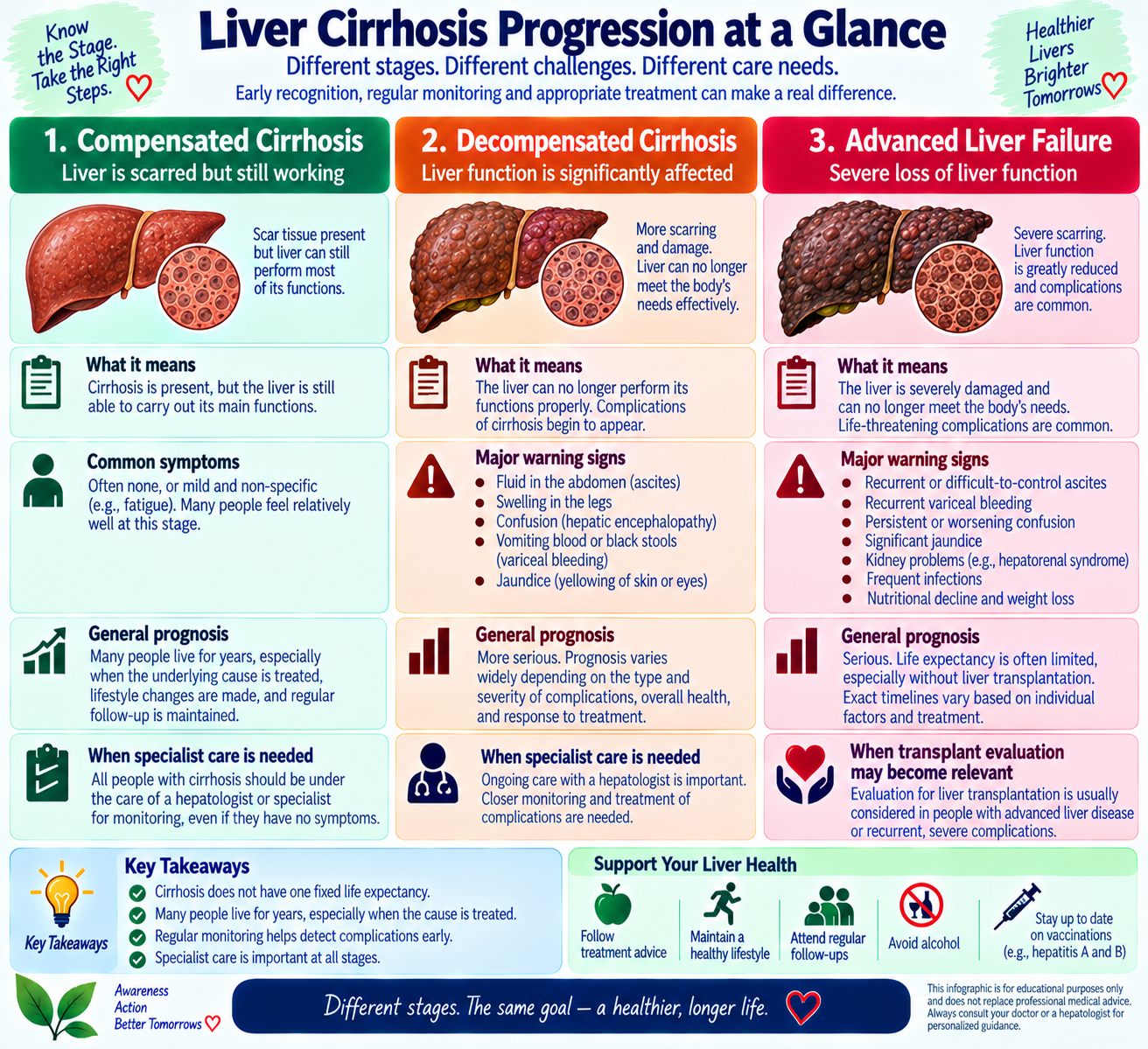
Cirrhosis is generally described clinically as compensated or decompensated.
| Stage | What it means | General outlook |
|---|---|---|
| Compensated cirrhosis | The liver is scarred but still performs its essential functions, and major complications have not developed. | Many people live for years; the Mayo Clinic reports an average life expectancy of more than 10 years. |
| Decompensated cirrhosis | Major complications such as ascites, variceal bleeding, jaundice, or hepatic encephalopathy have developed. | Prognosis is substantially worse, and specialist care is important. |
| Advanced liver failure | Liver function is severely impaired, and complications may become recurrent or difficult to control. | Liver transplant evaluation may be appropriate for some people. |
Mayo Clinic explains that prognosis changes significantly once cirrhosis becomes decompensated. It currently reports an average life expectancy of about two years without liver transplantation for decompensated cirrhosis. This should not be interpreted as a personal countdown because individual outcomes vary considerably.
The Mayo Clinic explanation of cirrhosis prognosis provides more detail about compensated and decompensated disease.
What Is Liver Cirrhosis?
Cirrhosis is advanced scarring of the liver.
Repeated liver injury causes healthy liver tissue to be replaced by scar tissue. As scarring progresses, the normal structure of the liver changes, and blood flow through the liver can become restricted.
The liver performs many essential functions.
- It helps process nutrients.
- It produces important proteins.
- It processes medications and other substances.
- It helps regulate metabolism.
- It produces bile for digestion.
- It also plays an important role in immune function and blood clotting.
Cirrhosis can result from several different liver diseases. Common causes include alcohol-associated liver disease, chronic hepatitis B or C, metabolic dysfunction-associated steatotic liver disease, autoimmune liver diseases, genetic disorders, and diseases affecting the bile ducts.
The Mayo Clinic overview of cirrhosis explains how different causes can lead to progressive liver scarring.
How Long Can You Live With Liver Cirrhosis?
There is no single answer.
The most important distinction is whether the disease is compensated or decompensated.
Someone with compensated cirrhosis may have little or no obvious symptoms and can sometimes remain stable for many years.
Decompensated cirrhosis means the liver disease has progressed enough for major complications to appear.
These complications can include:
- Ascites
- Hepatic encephalopathy
- Variceal bleeding
- Jaundice
- Kidney dysfunction
- Serious infections
- Liver cancer
The appearance of these complications changes the prognosis.
The American Association for the Study of Liver Diseases (AASLD) defines hepatic decompensation around major events such as ascites, hepatic encephalopathy, and variceal bleeding.
This is why asking only “What is the life expectancy of cirrhosis?” can be misleading.
A better question is
“What stage is the cirrhosis, what caused it, and what complications are present?”
Compensated Cirrhosis Life Expectancy
Compensated cirrhosis means the liver has significant scarring but is still able to perform its essential functions well enough that major decompensating complications have not appeared.
Some people have no obvious symptoms.
Others may have fatigue, abnormal blood tests, low platelets, or other subtle findings.
The outlook can be considerably better than in decompensated disease.
Mayo Clinic currently states that average life expectancy in compensated cirrhosis is more than 10 years, although individual outcomes vary.
That number should not be treated as a guarantee.
A person may remain compensated for many years, while another person can progress more quickly.
The underlying cause is particularly important.
For example, treating viral hepatitis, stopping alcohol exposure, or addressing metabolic liver disease can reduce ongoing liver injury.
Decompensated Cirrhosis Life Expectancy
Decompensated cirrhosis is more advanced.
It means complications have developed because the liver and related circulatory systems can no longer maintain normal function.
Common signs include:
- Fluid accumulation in the abdomen
- Leg swelling
- Gastrointestinal bleeding
- Confusion or changes in alertness
- Jaundice
- Recurrent infections
- Kidney problems
The development of one of these complications deserves medical attention.
Mayo Clinic currently reports an average life expectancy of about two years for decompensated cirrhosis without liver transplantation, but this is a population-level estimate rather than an individual prediction.
Some people may live longer.
Others may deteriorate faster.
Treatment of the underlying cause, management of complications, nutritional support, and timely transplant evaluation can all influence the course.
What Factors Affect Liver Cirrhosis Life Expectancy?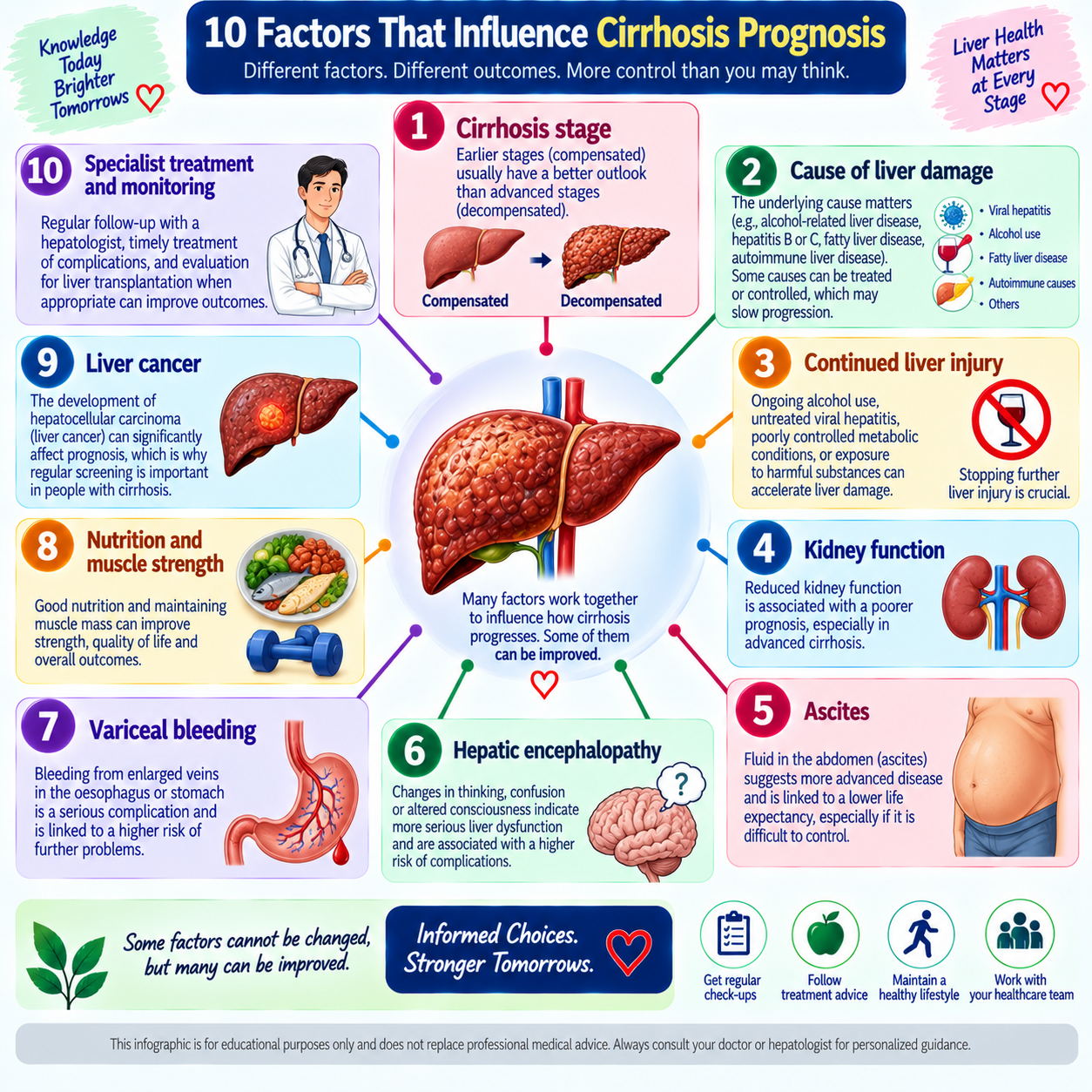
Several factors influence liver cirrhosis prognosis.
1. Stage of Cirrhosis
The difference between compensated and decompensated disease is one of the most important factors.
2. Cause of Liver Damage
Cirrhosis caused by alcohol, viral hepatitis, metabolic liver disease, autoimmune disease, or another condition may require different treatment.
3. Continued Liver Injury
Ongoing alcohol exposure, uncontrolled viral hepatitis, or other untreated causes can increase the risk of progression.
4. Kidney Function
Kidney problems are particularly important in advanced liver disease and can worsen prognosis.
5. Ascites
Ascites means fluid has accumulated inside the abdomen.
It is one of the classic signs of decompensation.
6. Hepatic Encephalopathy
This can cause confusion, sleep changes, difficulty concentrating, personality changes, or reduced alertness.
7. Variceal Bleeding
Portal hypertension can cause enlarged veins in the esophagus or stomach. If these veins rupture, severe internal bleeding can occur.
8. Nutrition and Muscle Strength
Poor nutrition and loss of muscle mass are common concerns in cirrhosis.
AASLD highlights malnutrition, frailty, and sarcopenia as important complications because loss of muscle mass is associated with poorer outcomes.
The AASLD guidance on nutrition and frailty in cirrhosis explains why maintaining adequate nutrition and muscle mass matters.
9. Liver Cancer
People with cirrhosis have an increased risk of hepatocellular carcinoma.
Regular surveillance is therefore an important part of long-term management.
10. Access to Specialist Treatment
Regular follow-up with a liver specialist can help detect complications earlier and identify people who may benefit from advanced treatments or transplant evaluation.
MELD Score and Cirrhosis Prognosis
If you or a family member has advanced liver disease, you may hear doctors discuss the MELD score.
MELD stands for the Model for End-Stage Liver Disease.
It is a clinical scoring system used to estimate the severity of advanced liver disease and help assess urgency for liver transplantation.
The score uses laboratory information rather than symptoms alone.
Mayo Clinic explains that MELD scoring is used to estimate mortality risk in people with advanced liver disease and helps determine transplant priority.
A higher MELD score generally indicates more severe disease and greater urgency.
The Mayo Clinic MELD score information also emphasizes that the score can change over time and should be interpreted by the healthcare team.
Why MELD Is Important
A person may look relatively well but still have significant laboratory abnormalities.
Another person may have obvious complications.
MELD provides clinicians with an objective way to assess disease severity.
However, it is not a crystal ball.
It cannot tell one person exactly how many years they will live.
Mayo specifically notes that MELD results should not be used alone to make individual treatment decisions.
What Is the Child-Pugh Score?
Another system used to assess the severity of chronic liver disease is the Child-Pugh classification.
It considers several clinical and laboratory factors, including
- Bilirubin
- Albumin
- INR or clotting function
- Ascites
- Hepatic encephalopathy
The result helps clinicians categorize the severity of liver dysfunction.
MELD and Child-Pugh are different tools.
They should not be interpreted as personal life-expectancy calculators without medical context.
Can Cirrhosis Be Reversed?
Established cirrhosis involves significant scar tissue, and advanced scarring generally cannot simply be returned to completely normal liver tissue.
However, that does not mean nothing can be done.
Treating the underlying cause can slow or stop additional injury.
In some situations, improvement in liver function and even recompensation can occur after the cause and complications are effectively treated.
This is particularly important because the goal is not simply to “cure the scar.”
The goal is to prevent further damage, control complications, preserve liver function, and improve quality of life.
Mayo Clinic explains that early treatment of the underlying cause can limit further liver damage.
Can Stopping Alcohol Improve Cirrhosis Prognosis?
If alcohol is contributing to liver disease, stopping alcohol is one of the most important steps.
This applies even if the cirrhosis has another contributing cause.
Continuing alcohol exposure can worsen liver injury.
Stopping alcohol can remove an ongoing source of damage and allow the medical team to focus on treating the remaining problems.
If alcohol dependence is present, stopping suddenly may require medical support because withdrawal can be dangerous.
Do not rely on willpower alone when withdrawal symptoms are a concern.
Professional treatment can make the process safer.
Cirrhosis Diet: What Should You Eat?
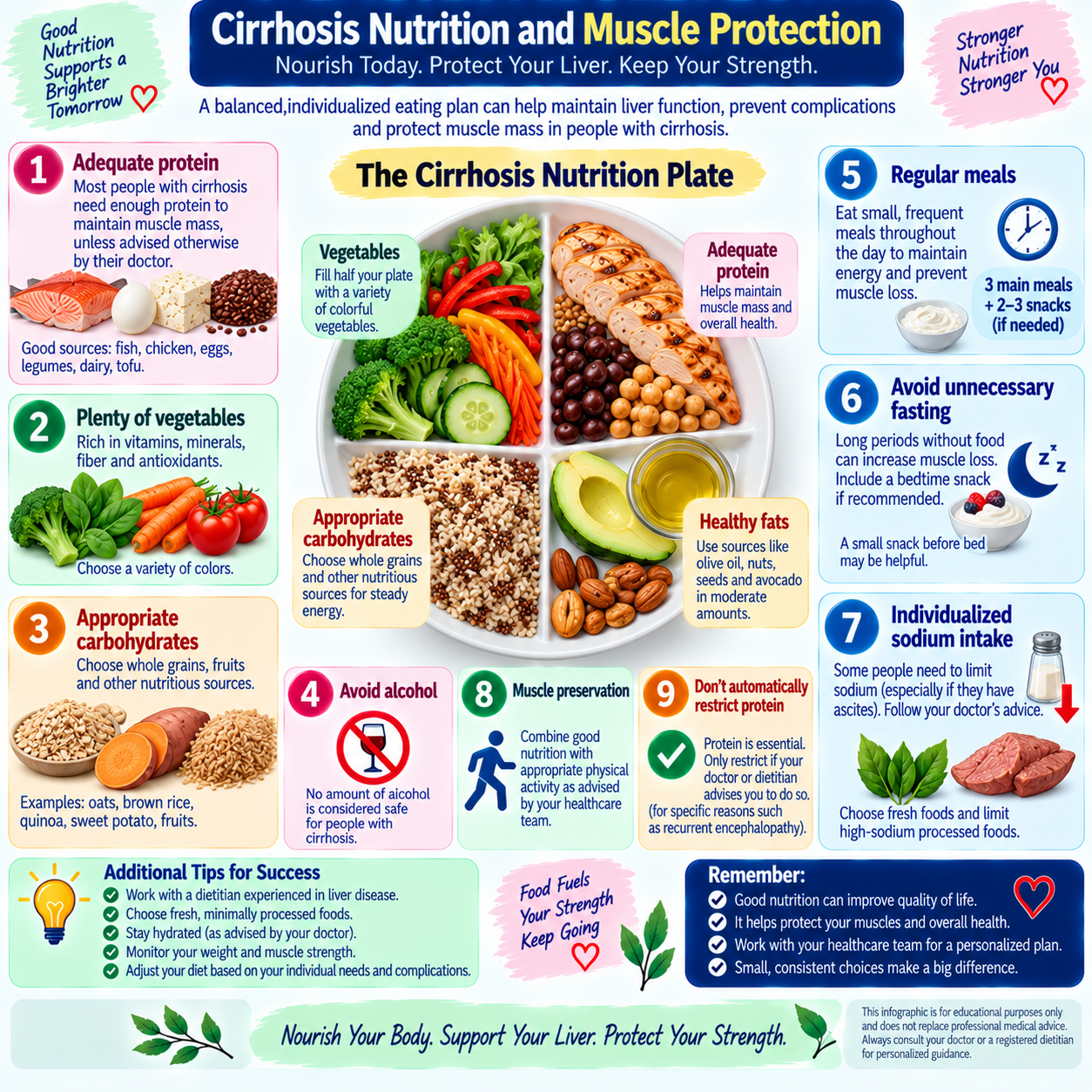
Nutrition in cirrhosis is more complicated than simply saying “eat healthy food.”
People with cirrhosis can become malnourished even when they are heavier.
Muscle loss is also common.
AASLD guidance emphasizes adequate protein and calories and recommends avoiding unnecessary fasting.
For many stable adults with cirrhosis, AASLD guidance supports approximately 1.2–1.5 grams of protein per kilogram of ideal body weight per day, with individualized adjustment.
Importantly, protein should not automatically be restricted because someone has hepatic encephalopathy.
This is an important correction to older nutrition advice.
The AASLD discussion of malnutrition in cirrhosis explains the importance of protein, frequent meals, muscle preservation, and individualized nutrition.
Practical Eating Pattern
A person with cirrhosis may be advised to:
- Eat regular meals
- Include adequate protein
- Avoid long fasting periods
- Choose nutrient-dense foods
- Follow individualized sodium advice
- Avoid alcohol
- Work with a dietitian when nutrition is difficult
A Simple Meal Structure
A practical plate might contain:
Protein: eggs, fish, poultry, dairy, beans, or another suitable source
Vegetables: cooked or fresh vegetables according to tolerance
Whole-food carbohydrate: an appropriate portion of grains, potatoes, fruit, or another suitable source
Healthy fat: a modest amount of nuts, seeds, or plant oils when appropriate
The exact diet should be individualized.
Should Salt Be Limited With Cirrhosis?
This depends on the person’s condition.
People with ascites are commonly advised to restrict dietary sodium.
AASLD educational guidance discusses a target of less than approximately 2 grams of sodium per day for patients with ascites, while also warning that excessive dietary restriction can contribute to poor food intake and malnutrition.
- This creates an important balance.
- The goal is not simply “eat as little salt as possible.”
- The goal is to control fluid retention without causing inadequate nutrition.
A doctor or registered dietitian can personalize this.
Exercise With Cirrhosis
Exercise can be beneficial, but the right type depends on disease severity.
Cirrhosis can be associated with muscle loss and frailty.
AASLD educational guidance supports appropriately tailored aerobic and resistance activity to help preserve muscle function.
However, someone with severe ascites, recent gastrointestinal bleeding, significant weakness, dizziness, or advanced complications should not begin a demanding exercise program without medical guidance.
A gentle walking routine may be appropriate for some people.
Resistance training may be useful for others.
The program should match the person’s medical condition.
Practical Daily Habits That May Help
These are not cures for cirrhosis.
They are practical habits that can support medical treatment.
Keep Every Medical Appointment
Cirrhosis requires ongoing monitoring.
Do not wait until symptoms become severe.
Take Medicines Exactly as Prescribed
Do not stop medications because you feel better.
Some cirrhosis medicines are used to prevent serious complications.
Avoid Alcohol
If you have cirrhosis, alcohol should generally be avoided.
Ask Before Taking New Medicines
Some medicines and supplements can be unsafe in advanced liver disease.
This includes products that appear “natural.”
Protect Muscle Mass
Adequate protein and appropriate physical activity can help address frailty and muscle loss.
Keep Vaccinations Up to Date
People with chronic liver disease may need specific vaccinations depending on age, health status, and national recommendations.
Track Changes
Pay attention to:
- Increasing abdominal swelling
- Rapid weight changes
- Leg swelling
- Increasing confusion
- Vomiting blood
- Black stools
- Worsening jaundice
- Reduced urine output
These changes should not be ignored.
Unique People-First Strategy: Create a Cirrhosis Health Folder
One simple habit that can make medical appointments easier is keeping a single folder containing:
- Medication list
- Recent blood test results
- Imaging reports
- Hospital discharge summaries
- MELD information when provided
- List of symptoms
- Questions for the liver specialist
- Emergency contact information
This does not treat cirrhosis.
But it can make communication easier, particularly when several healthcare professionals are involved.
Another Practical Strategy: Track Changes, Not Just Symptoms
Instead of writing:
“I feel worse.”
Record measurable changes.
For example:
| What to track | Why it matters |
|---|---|
| Abdominal swelling | May indicate worsening fluid accumulation |
| Weight changes | Can reflect fluid changes rather than body-fat changes |
| Mental alertness | May help identify changes in encephalopathy |
| Appetite | Important for nutrition |
| Walking ability | Can reflect muscle strength and frailty |
| Medication adherence | Helps identify treatment problems |
Do not use these measurements to diagnose yourself.
Use them to give your healthcare team better information.
When Cirrhosis Needs Urgent Medical Attention
Some symptoms require immediate medical evaluation.
Seek emergency care for:
- Vomiting blood
- Black or bloody stools
- Severe confusion
- Loss of consciousness
- Severe difficulty breathing
- Sudden severe abdominal pain
- High fever with worsening illness
- Rapidly worsening jaundice
- Very little or no urine
- Severe weakness or fainting
Variceal bleeding can be life-threatening.
Severe hepatic encephalopathy can impair consciousness and safety.
A person with cirrhosis should not wait at home hoping these problems will disappear.
When Is Liver Transplant Considered?
Liver transplantation can become an important treatment option when cirrhosis progresses to advanced liver failure or complications that cannot be adequately controlled.
Transplant evaluation does not necessarily mean that a transplant will happen immediately.
The transplant team considers multiple factors.
These may include:
- Liver disease severity
- MELD score
- Complications
- Kidney function
- Other medical conditions
- Liver cancer status
- Overall suitability for transplantation
Mayo Clinic explains that decompensation and advanced liver disease can lead to transplant evaluation and that MELD helps assess urgency.
The Mayo Clinic MELD information provides current information about how this scoring system is used.
Cirrhosis Life Expectancy: What the Numbers Cannot Tell You
Statistics are useful.
But they have limitations.
Suppose a study reports an average survival time.
That number describes a group.
It does not tell you exactly what will happen to one individual.
Two people can have the same diagnosis but very different:
- Causes
- MELD scores
- Kidney function
- Nutrition
- Alcohol exposure
- Complications
- Treatment response
- Age
- Other medical conditions
This is why a doctor should interpret prognosis using the complete clinical picture.
Avoid websites that promise an exact number of remaining years from a diagnosis alone.
Common Mistakes People Make After a Cirrhosis Diagnosis
Mistake 1: Assuming Cirrhosis Always Means Immediate Liver Failure
Cirrhosis can remain compensated for many years.
Mistake 2: Stopping Treatment Because Symptoms Improve
Improvement does not necessarily mean the underlying disease has disappeared.
Mistake 3: Trying Detox Drinks
Lemon water, herbal drinks, and “liver detox” products cannot replace treatment for cirrhosis.
Some herbal supplements can actually cause liver injury or interact with medications.
Mistake 4: Eating Too Little Protein
Older advice sometimes encouraged protein restriction in people with hepatic encephalopathy.
Current guidance does not support routine protein restriction for this reason.
Mistake 5: Following an Extremely Restrictive Diet
Severe restriction can worsen malnutrition and muscle loss.
Mistake 6: Ignoring Muscle Loss
Weakness and reduced muscle mass are important problems in cirrhosis.
Mistake 7: Taking Over-the-Counter Medicines Without Asking
Advanced liver disease changes how some medicines should be used.
Always ask your healthcare professional or pharmacist.
Mistake 8: Assuming Supplements Are Safe Because They Are Natural
Natural does not automatically mean liver-safe.
Mistake 9: Waiting for Pain
Cirrhosis may progress without obvious liver pain.
Regular medical monitoring matters.
What Current Research Is Showing
Recent clinical work continues to focus on predicting which people with cirrhosis will deteriorate, how to identify decompensation earlier, and how to improve transplant decision-making.
A 2026 Mayo Clinic report described research into an AI-based ACE score designed to predict decompensation and liver-related outcomes. The development reflects a broader research direction: combining clinical data to identify patients at higher risk earlier rather than relying on a single measurement.
This is promising research, but it should not be interpreted as a replacement for established clinical assessment.
The Mayo Clinic 2026 discussion of AI-based prediction in cirrhosis describes the research and its intended role in risk stratification.
Another important research and clinical-development area is recompensation.
In some patients, successful treatment of the underlying cause and complications can lead to improvement after decompensation.
Recent AASLD meeting data have also examined recompensation in people with hepatitis C-related decompensated cirrhosis after antiviral treatment.
This does not mean advanced cirrhosis can always be reversed.
It does show why treatment should not be abandoned simply because the disease has become complicated.
A Simple Cirrhosis Care Checklist
Use this checklist to discuss your care with your healthcare team.
- Do I know the cause of my cirrhosis?
- Am I compensated or decompensated?
- What is my current MELD score?
- Has my doctor assessed my nutrition and muscle strength?
- Do I need sodium restriction?
- Am I getting enough protein?
- Do I need liver cancer surveillance?
- Have I been assessed for varices or portal hypertension?
- Are my medications safe for my liver condition?
- Do I need vaccination updates?
- Should I be evaluated by a hepatologist?
- Is liver transplant evaluation appropriate?
These questions can help turn a frightening diagnosis into a more structured care plan.
Frequently Asked Questions
What is the liver cirrhosis life expectancy by stage?
Compensated cirrhosis generally has a much better outlook than decompensated cirrhosis. Mayo Clinic currently reports an average life expectancy of more than 10 years for compensated cirrhosis and about two years without transplant for decompensated cirrhosis. These are population averages, not individual predictions.
How long can you live with compensated cirrhosis?
Many people live for many years with compensated cirrhosis. The exact outlook depends on the cause, age, other health conditions, treatment, laboratory results, and whether complications develop.
What is decompensated cirrhosis life expectancy?
Decompensated cirrhosis has a substantially poorer prognosis than compensated disease. Mayo Clinic currently reports an average life expectancy of about two years without liver transplantation, but individual outcomes vary.
Can compensated cirrhosis become decompensated?
Yes. Cirrhosis can progress and develop complications. Treating the underlying cause and monitoring for complications can help reduce risk and allow problems to be addressed earlier.
Can stopping alcohol improve cirrhosis prognosis?
If alcohol is contributing to liver injury, stopping alcohol is an important part of treatment. People with alcohol dependence may need medical support to stop safely.
Can cirrhosis be reversed?
Established scar tissue generally cannot simply be removed. However, treating the cause can reduce ongoing injury, and some people can experience improvement in liver function and complications.
What MELD score is considered serious?
MELD is interpreted as a continuum rather than a simple “safe” or “unsafe” number. Higher scores generally indicate more severe disease and greater urgency for transplant evaluation. Your liver specialist should interpret your specific score.
Does diet improve cirrhosis life expectancy?
Nutrition is important in cirrhosis, particularly because malnutrition and muscle loss can occur. Diet does not cure cirrhosis, but appropriate nutrition can support overall health and treatment.
Should people with cirrhosis avoid protein?
Routine protein restriction is not recommended simply because a person has hepatic encephalopathy. AASLD guidance emphasizes adequate protein intake and muscle preservation.
Is liver transplant the only treatment for advanced cirrhosis?
No. Treatment depends on the cause and complications. However, transplant can become an important option when liver function is severely compromised or complications become difficult to control.
What are signs that cirrhosis is getting worse?
Increasing abdominal fluid, leg swelling, jaundice, gastrointestinal bleeding, confusion, recurrent infections, kidney problems, and worsening weakness can be warning signs.
Author Note
My goal with this article is to make a frightening medical topic easier to understand without giving false reassurance or unnecessary fear.
I have deliberately avoided presenting an invented patient story as personal medical experience. A made-up case may sound persuasive, but it does not provide genuine evidence.
The practical message is more useful: cirrhosis is serious, but prognosis is not determined by the word “cirrhosis” alone.
Stage, cause, complications, treatment, nutrition, kidney function, and transplant options all matter.
If you or someone close to you has cirrhosis, use this article to prepare questions for your healthcare team rather than trying to calculate an individual life expectancy from online statistics.
Medical Disclaimer
This article is for general educational purposes only.
It does not diagnose cirrhosis or provide individualized medical advice.
Life-expectancy statistics describe groups of patients and cannot predict how long one individual will live.
People with cirrhosis should work with a qualified healthcare professional, preferably a gastroenterologist or hepatologist when appropriate.
Do not stop prescribed medicines, begin a restrictive diet, take supplements, or change alcohol use without appropriate medical guidance.
Seek urgent medical attention for vomiting blood, black stools, severe confusion, loss of consciousness, severe breathing difficulty, or other potentially life-threatening symptoms.
Fitness Disclaimer
Exercise recommendations in this article are general educational information.
People with cirrhosis can have very different levels of liver function, muscle strength, fluid retention, anemia, bone health, and cardiovascular fitness.
A person with advanced cirrhosis, significant ascites, recent bleeding, severe weakness, or other complications should receive individualized advice before beginning or increasing exercise.
A qualified healthcare professional or exercise specialist familiar with the person’s medical condition can help determine an appropriate activity plan.
Research Methodology
This article was developed using current information from major medical organizations and peer-reviewed evidence.
Priority was given to:
- Mayo Clinic
- American Association for the Study of Liver Diseases
- Cleveland Clinic
- Peer-reviewed liver research
- Current clinical guidance
- Recent research on prognosis and risk prediction
The review focused particularly on compensated and decompensated cirrhosis, MELD scoring, complications, nutrition, muscle loss, alcohol cessation, treatment, transplantation, and emerging prognosis research.
Population-level statistics have been clearly separated from individual prognosis wherever possible.
Conclusion
Liver cirrhosis life expectancy by stage varies considerably.
Compensated cirrhosis generally has a much better outlook than decompensated cirrhosis.
Mayo Clinic currently reports that people with compensated cirrhosis may have an average life expectancy of more than 10 years, while average survival after decompensation may fall to about two years without liver transplantation.
Those numbers are important, but they are not a personal countdown.
Your actual prognosis depends on the cause of cirrhosis, liver function, kidney health, complications, MELD score, nutrition, muscle strength, treatment, alcohol exposure, and other medical factors.
The most useful response to a cirrhosis diagnosis is not panic.
It is action.
Find out what caused the liver damage.
Ask whether the disease is compensated or decompensated.
Understand your MELD score when appropriate.
Take prescribed treatment seriously.
Avoid alcohol when advised.
Protect your nutrition and muscle strength.
Attend regular medical appointments.
Ask about cancer surveillance and other complication screening.
And if your doctor believes advanced liver disease is present, ask whether transplant evaluation should be considered.
Cirrhosis is serious.
But a diagnosis does not tell the entire story.
The stage, cause, complications, treatment response, and quality of ongoing care all help shape the outlook.
Sources
- Mayo Clinic — Cirrhosis: Diagnosis and Treatment
- AASLD — Outpatient Management of Cirrhosis
- AASLD—Ascites and Cirrhosis Practice Guidance
- AASLD—Malnutrition, Frailty and Sarcopenia in Cirrhosis
- Cleveland Clinic — Cirrhosis of the Liver
- PubMed — Biomarkers Predicting Decompensation in Compensated Cirrhosis
- PubMed — Prognostic Biomarkers for Predicting Decompensation
- PubMed — Preventing Progression of Cirrhosis to Decompensation and Death
- PubMed — Prognosis Algorithms for Acute Decompensation of Cirrhosis
- Mayo Clinic — MASLD Survival Rates
Similar Posts
- 10 Causes of High Blood Pressure & Treatment
- Bad Cholesterol and How to Combat It
- 7 Simple Health Changes to Reduce The Risk of Chronic Disease
- 6 Ways to Detox Your Body Holistically: A Comprehensive Guide
- Home
- Category











[…] Liver Disease Cirrhosis life Expectancy […]
[…] Liver Disease Cirrhosis life Expectancy […]
[…] Liver Disease Cirrhosis life Expectancy […]
[…] Liver Disease Cirrhosis life Expectancy […]
[…] Liver Disease Cirrhosis life Expectancy […]
[…] Liver Disease Cirrhosis life Expectancy […]